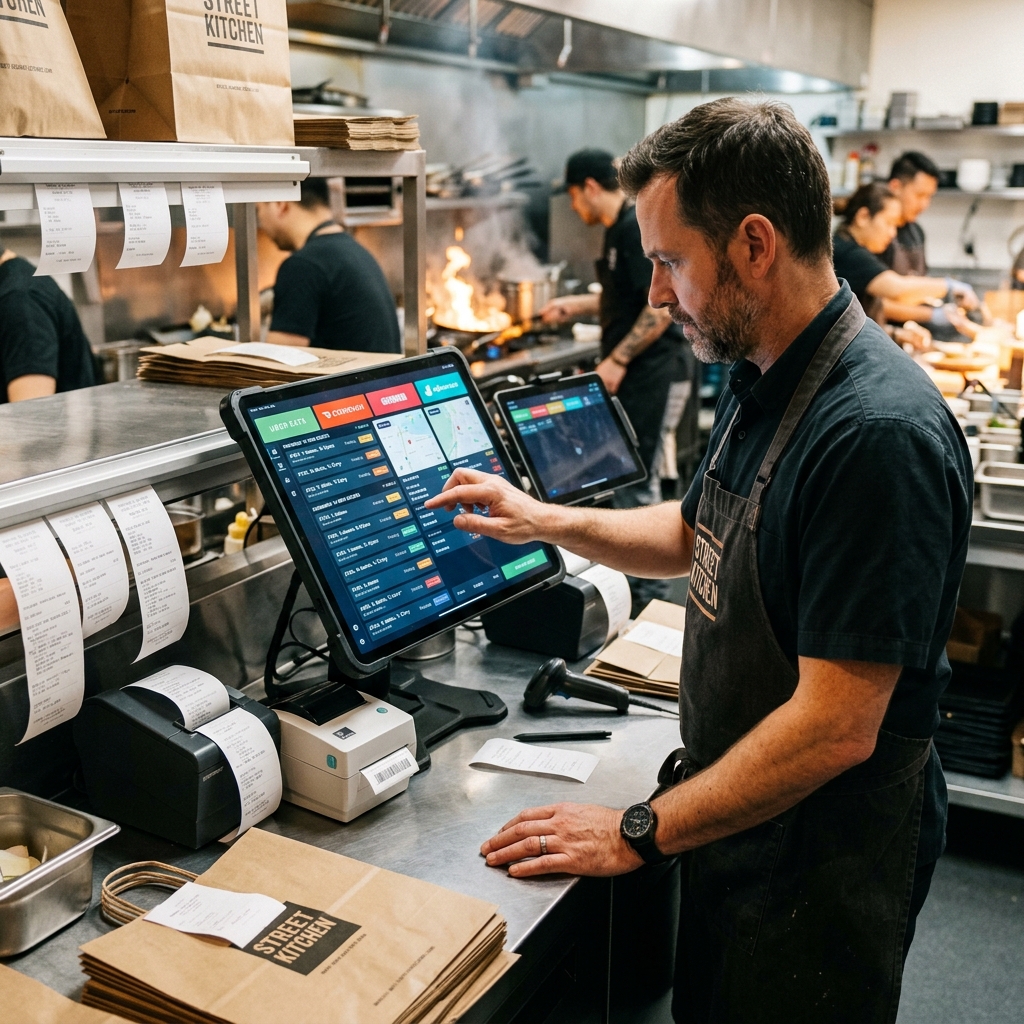
If your restaurant is like the vast majority in India, Zomato and Swiggy now make up a highly significant portion of your daily orders. However, managing these orders effectively poses a massive operational headache for front-of-house staff.
The Problem with "Tablet Hell"
You have a tablet for Zomato. You have a tablet for Swiggy. You have your main POS for dine-in. When a delivery order comes in, a staff member has to manually accept it on the platform tablet, read the order, and then manually punch that order into your POS system to print the KOT for the kitchen.
This creates a series of critical failures during peak hours:
- Human Error: Punching in 3 Biryanis instead of 2, or missing a "no onion" modifier.
- Delayed Firing: The kitchen doesn't start cooking until the staff manually enters the order.
- Inventory Desync: If you run out of an item, you have to go to three separate tablets to mark the item as out of stock.
The Power of Unified API Integration
A modern Restaurant POS System solves "Tablet Hell" via API integration.
When an order is placed on Swiggy or Zomato, the order flows instantly into your SwadPOS dashboard. The system accepts the order automatically (if configured to do so), and fires the digital KOT directly to the kitchen display or printer within milliseconds. It then recalculates stock. If an inventory item hits absolute zero, SwadPOS automatically contacts the Zomato and Swiggy APIs and marks that menu item as disabled across all platforms.
Scaling Up
If you're opening your second location, or scaling a cloud kitchen, this level of automation isn't a luxury, it's a requirement to achieve high volume capability without exponentially expanding your labor costs. With unified integration, what used to require a dedicated staff member now happens completely invisibly in the background.
Integrate Your Delivery Platforms
Stop manually punching in orders. SwadPOS integrates with Zomato and Swiggy to automate your delivery pipeline. Let's grow your revenue today.
Start Scaling →